The aircraft doors open, the cabin fills with the sound of seatbelts releasing, and every passenger faces the same question at once: what happens next, and in what order? Some travelers already know whether they need a gate transfer or a border queue. Others are still working it out. Arrival planning is mostly the discipline of answering that question before landing — because the airport itself is a sequence of decisions, not a single event.
This overview treats that sequence step by step, flagging the variables that change the outcome for different airports and different travelers, without pretending any two airports — or two travelers — move through it identically.
Why the First Ten Minutes After Landing Shape Everything Else
Disembarkation order matters more than most travelers expect. Passengers seated forward, or flying in premium cabins, typically leave first; families with strollers and travelers using wheelchairs or mobility aids often need to wait for assistance equipment to reach the gate. That equipment is usually arranged through the airline, and it should be requested when the ticket is booked or at check-in — not assumed to be standing by. ACI World's Airport Accessibility Handbook notes that pre-booking special assistance gives ground teams time to coordinate, and that walking distances and elevator locations vary substantially between terminals.
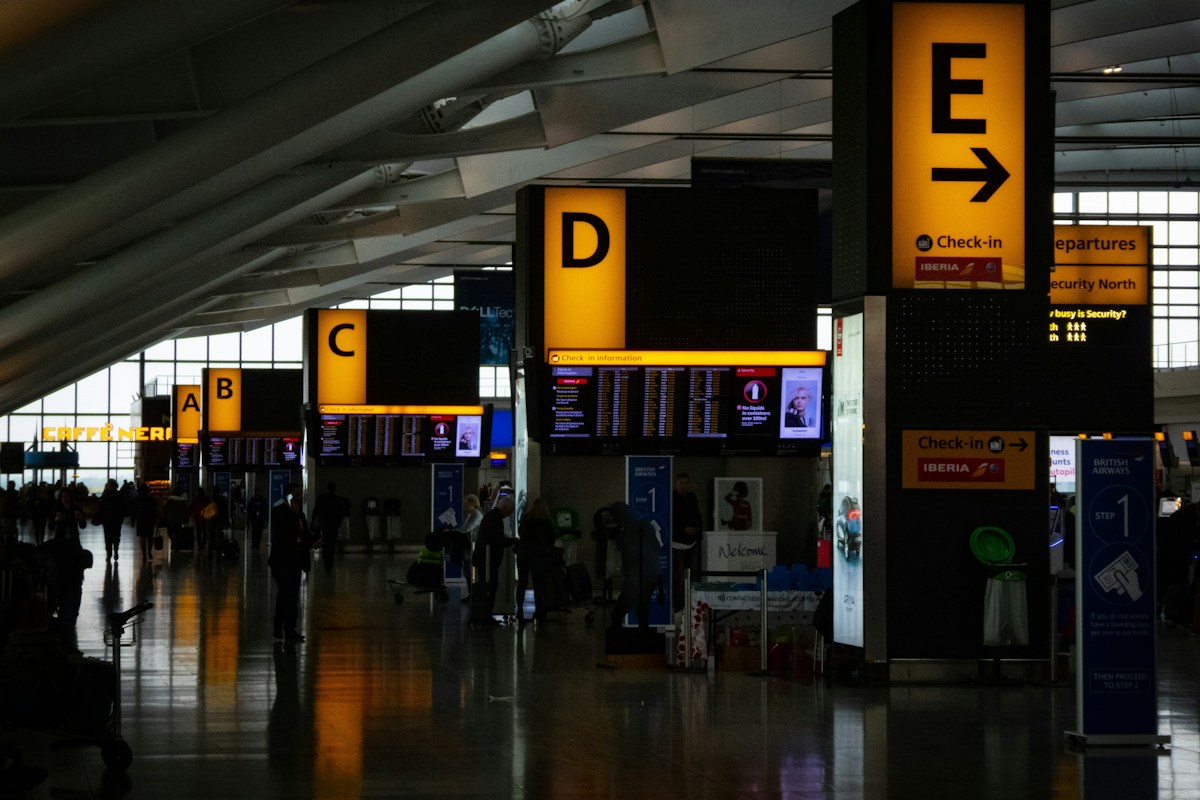
From the jet bridge, the next wayfinding decision is usually one of three: follow signs to flight connections, to immigration, or to baggage claim. In many large airports these are separate corridors, and choosing the wrong one can mean a long walk back. At some airports, transfer passengers clear security again even when they never leave the terminal. At Los Angeles International (LAX), for example, passengers connecting between terminals generally must exit and re-clear Transportation Security Administration screening unless they are on a through-checked itinerary using an airside connector; at London Heathrow, passengers transferring between certain terminals — such as a Terminal 5 to Terminal 3 connection — may need to pass through a security screening point even though they stay airside. These differences are set by airport design and national border rules, not by airline preference. Check the layout for your specific airport and terminal on the airport's official website before you fly.
For a long connection, a lounge or airport hotel booking can turn dead time into rest. Treat any booking platform as a supplement to — not a replacement for — the airport's own published maps and connection guidance (see {{AWIN_MERCHANT_LINK_1}}). Official terminal maps and minimum connection time tables, usually published by the airport operator and by IATA, are the documents that tell you whether a given transfer is physically realistic.
Documents, Queues, and the Parts You Cannot Control
Border entry is the least predictable stage of any international arrival. Queue lengths vary by hour, by terminal, and by the number of desks staffed at that moment. ACI World's Airport Service Quality (ASQ) programme surveys passenger satisfaction across participating airports, and wait-time reporting appears in many airport performance reviews — but no published figure guarantees your wait on a given flight. Travelers eligible for automated e-gates, registered-traveler programs, or fast-track lanes may move faster, subject to eligibility rules set by the destination country.
What travelers can control is preparation. A practical document checklist for most international arrivals includes:
- Passport validity. Rules are set by the destination, not by the airline. The Schengen area requires a passport valid for at least three months beyond the planned date of departure from Schengen territory, and issued within the previous ten years; the United States, for Visa Waiver Program travelers, requires an e-passport valid for the duration of stay. Check the specific rule for your nationality and destination before booking.
- Visa or electronic travel authorization where applicable, printed or saved offline as well as on a phone — commonly requested at land and air borders in the US (ESTA), Canada (eTA), and the UK (ETA).
- Proof of onward travel and accommodation details, which border officers at many destinations, including the UK and Schengen states, may reasonably request.
- Completed arrival or customs declaration forms, paper or digital depending on the airport — still routine at some land borders and at airports in countries without universal digital pre-clearance.
Language access varies too. Major hub airports commonly offer multilingual signage and interpreter services at immigration, but smaller regional airports may not. If a traveler does not speak the destination's primary language, carrying key details — address of stay, purpose of visit, return date — written down in the local language helps at the desk.
Baggage Claim, Pickup, and the Communication Plan
Baggage delivery times are influenced by aircraft type, baggage volume, and how far the carousel is from the ramp. With a checked bag, plan for meaningful time between deplaning and leaving the terminal, and know that oversize and special-item baggage often arrives at a separate desk. If a bag is delayed, the airline's baggage services desk — not the airport information counter — is the correct first stop.
Pickup logistics are where arrivals most often go sideways, and almost always because of a communication gap. Curbside rules differ sharply: some airports allow private cars to wait at the terminal curb, others restrict that lane to taxis and licensed shuttles, and many large hubs direct all private pickups to a designated lot or cell-phone waiting area. At San Francisco International (SFO), for example, private vehicles cannot wait at the terminal curb and must use the cell-phone lot until the arriving passenger is curbside; rideshare pickup points at most large hubs sit a level or a short walk away from the arrivals hall. The workable plan is to agree in advance on a meeting point named in the airport's own published guidance, to share live location or flight status, and to set a fallback — such as meeting at a named café or information desk — if the first plan fails. Travelers using assisted transport, traveling with young children, or arriving with heavy luggage should build extra buffer into pickup timing rather than treating it as a fixed appointment.
Two scenarios show how the four stages interact in practice. A traveler with a 75-minute connection at Frankfurt Airport (FRA) between a Schengen arrival and a non-Schengen departure faces immigration, a possible terminal change via the Sky Line people mover, and a security re-screen before reaching the gate; that sequence leaves little margin if the inbound flight is late, so the realistic options are to book a longer connection or to ask the airline at check-in whether a protected rebooking applies if the first leg slips. A family arriving at SFO on an international flight should plan for immigration, baggage claim, and customs before reaching the arrivals curb — and should have the driver wait in the cell-phone lot, with a agreed text or call once bags are in hand, rather than circling the terminal.
Treat arrival as four separate stages — deplaning and wayfinding, border and customs, baggage, then ground transport — and prepare each stage independently. When one stage runs late, the others can still be managed if the plan anticipates it. The stages that most reward advance checking are the ones governed by rules rather than schedules: border eligibility, pickup zones, and accessibility assistance. Confirm all three with the airport's official site, the airline, and the relevant border authority before departure, and leave the rest to the day itself.