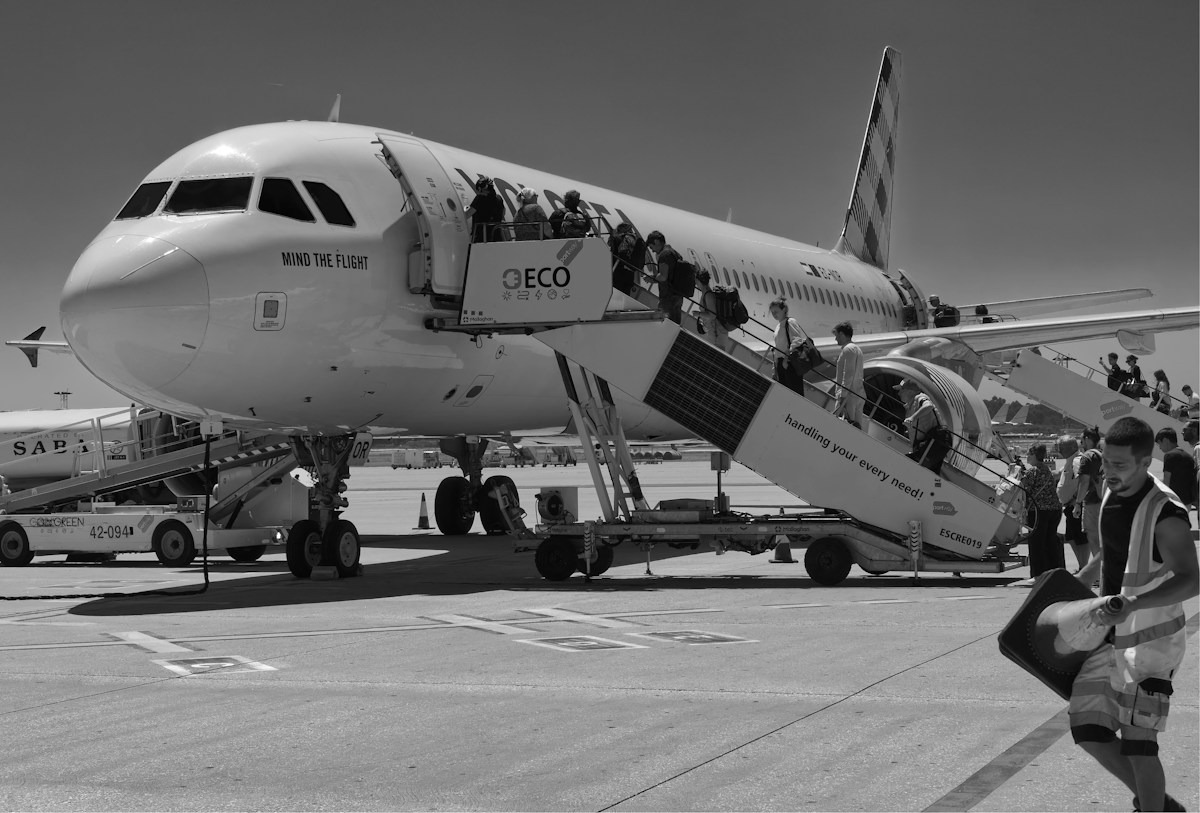
The aircraft has parked. Seatbelt signs are off, passengers are standing, and your phone still shows no message from the driver. Everything after this moment depends on decisions made before the flight landed: which terminal exit you agreed on, whether the driver can see your flight status, and whether your name will be on a sign or you'll be expected to call. Meet-and-greet services work best when the traveler understands the sequence — and the failure points — in advance.
Where the Arrival Sequence Actually Breaks
Consider a traveler flying into a large international hub with two checked bags, a tired child, and a pre-booked meet-and-greet. They land on time, clear immigration reasonably quickly, but wait 40 minutes at baggage claim. The driver, meanwhile, has been tracking the flight and sees "landed" — not "bags collected." Some providers build in a free waiting window after landing; others start the clock when the flight arrives and charge for overages. Neither policy is universal, and the difference should be confirmed in writing at booking.
This is where most pickup plans fail: not at the meeting point, but at the mismatch between what the traveler is doing and what the driver's system shows. A flight number tells a driver when you touched down. It does not tell them you're stuck behind a slow baggage belt or queuing for a visa-on-arrival stamp. Travelers should expect to message the driver or dispatcher once they've cleared baggage reclaim, and providers should expect the traveler's arrival to be unpredictable.
One useful benchmark: many airports publish recommended minimum connection and clearance times on their own websites, and those figures vary widely between terminals at the same airport. Treat any provider's quoted "average wait" as marketing rather than data, and check the airport's own guidance separately.
Building the Pickup Plan, Step by Step
The practical work starts well before departure. A meet-and-greet is a coordination product, and its quality depends on the information exchanged at booking.
- Confirm the meeting point in words, not just a pin. "Terminal 2 arrivals hall, next to the information desk" is clearer than coordinates. Ask for a written description and, where offered, a photo of the exact spot.
- Decide sign-on-arrival versus call-on-arrival. A name board suits travelers who want to walk out and spot someone immediately. A call or message suits travelers who need to change plans mid-arrival. Confirm which the provider actually offers.
- Share flight details and a backup contact. Give the flight number and a mobile number that works internationally, or confirm the provider's messaging app of choice.
- Ask about the waiting policy. Free waiting time after landing, charges for extra waiting, and what happens if the flight is delayed or diverted should all be in the confirmation.
- Flag accessibility and family needs. Wheelchair assistance, child seats, and extra luggage capacity are usually bookable but rarely automatic. Request them explicitly and ask for confirmation.
- Check vehicle and luggage fit. A sedan may not take four large cases. State bag counts and sizes at booking.
- Agree the drop-off address precisely. Hotel name, entrance, and district help; a street address alone can be ambiguous in cities with repeated street names.
None of this removes uncertainty. It simply moves the uncertainty to a point where it can be resolved — before the trip, rather than in a crowded arrivals hall.
What to Verify, and What to Accept as Variable
Some details are genuinely fixed by the airport, and some are fixed by the provider. Airport authorities typically publish terminal maps, arrivals hall layouts, and official taxi and pickup rules, and these are the most reliable source for where a driver can legally wait. Many airports restrict curbside waiting to actively loading vehicles, which is why meet-and-greet drivers often wait inside the terminal instead. Travelers should check the airport's own site for pickup zones rather than relying on a provider's summary.
Other details are contractual rather than factual. Whether a driver monitors the flight, how long they wait without charge, and whether they'll hold a sign inside or outside customs are all provider-specific. Confirm them in writing. Likewise, border-entry outcomes and queue times are decided by border authorities on the day — no pickup service can promise those, and any provider implying otherwise is overreaching.
For travelers comparing options, it helps to separate the product from the promise. A private transfer, a shared shuttle, and a meet-and-greet with a driver inside the terminal are different services with different failure modes. A useful first filter is simply whether the provider publishes its waiting policy and meeting-point details upfront; services that do are easier to hold to account. Travelers who want to compare vetted airport transfer and meet-and-greet options can start here: {{AWIN_MERCHANT_LINK_1}}.
The Editorial View: Prepare for the Handoff, Not the Ride
Meet-and-greet services are best judged on the ten minutes around the arrivals door, not the drive itself. The sign, the message, the waiting policy, and the accessibility request are where value is won or lost. A traveler who has confirmed all four has done most of the work already.
That means a reasonable preparation plan looks like this: book with a provider that states its meeting point and waiting terms in writing; share flight and contact details at least 24 hours ahead; request accessibility and family equipment explicitly; carry the provider's contact details offline as well as on a phone; and plan a fallback — an official taxi rank or airport information desk — in case the handoff goes wrong. None of this guarantees a smooth arrival. It does mean the traveler is not improvising in a terminal at midnight.
Finally, build slack into the plan. A driver who is told to expect the traveler two hours after landing is better positioned than one told to expect them 40 minutes after. The traveler controls that expectation, and setting it realistically is the most reliable thing in the whole sequence.